Monday, January 27, 2014

Blog 6: Readicide
Are you good with swapping out Of Mice and Men for Twilight,
for example? Or Macbeth for Hunger Games?
While I may not necessarily be the biggest fan of Macbeth or Hamlet, other books taught in English classes like Of Mice and Men and Catcher in the Rye were books that I will treasure forever as they
not only proved to be engaging, interesting books but they also taught me
numerous lessons about literature and life in general. If schools were to trade
these books in for more 21st century type books like Twilight and The Hunger Games, I think that a lot would be lost in a sense that
students will no longer grasp hold of the same life knowledge learned through
these classic stories. I suppose The Hunger
Games may serve to teach lessons about endurance and faith, but only on the
surface whereas the lessons about companionship, betrayal, self-worth, etc.
that are taught through the classic stories go deep into the heart and soul of
the novel and require understanding of language, style and literary elements.
These are the kind of books that further our ability to understand the world
around us and prepare us for the trials and tribulations that come throughout
life. They have some element of moral and/ or virtue that make the stories worth
reading. These classic stories also have some realistic qualities to them as
the experiences and challenges faced by Holden Caulfield relate to numerous
people on many different levels. The
Hunger Games and Twilight, on the
other hand, are stories set in completely unrealistic societies where the
characters face unrealistic situations that cannot be applied to modern day
life- that is unless you plan on fighting people to the death or transforming
into a blood sucking vampire (which is highly unlikely). All in all, when it
comes to sticking with the classics or trading in for the recent stuff, I say
stick with the classics. They serve far more purpose in preparing students for
life than Katniss Everdeen and Edward Cullen ever will.
Thursday, January 9, 2014
Blog 4: Book Number One Overview
I believe I mentioned this in a previous post but just as a reminder, I read Veronica Roth's Divergent for my first book and after completing it, I have to say that I am extremely satisfied with my decision. Not only was the book full of adventure and plot twists, but the characters and overall story line was very well developed and the writing itself was above average. I also was a fan of the budding relationship between Tris and Tobias and could not stop reading in anticipation of what might happen next. I highly recommend this book and I plan on continuing the series, hopefully reading both the second and the third book. I also am looking forward to the movie which won't be coming out for a while but seems to be promising thus far from the quality of the actors chosen to play the characters and the short snippets of information that come out regarding the film. In general, I am really happy with this book and my decision to read it and I can't wait to see what happens next as the series continues.
Blog 5: Adapting My Book
The book that I am reading is Silver Linings Playbook by Matthew Quick. In general, the book seems like it would be pretty easy to transform into a movie in that the overall story line is fairly basic. The story itself is realistic as it recounts the life of Pat Peoples, who has spent the past four years in a mental instutions, and his journey in gaining his life back and finding peace with his situation. Being such a realistic story, recreating it through film, in my mind, would not be very challenging. There are some scenes, however, that could be somewhat difficult to remake in that they encompass numerous aspects that are sometimes better understood through writing than through acting. I also think that it would be difficult to keep the same format as the book which is journal entries. The book tells Pat's story through his own writing about his day to day life. It would be hard to do this in a film in that there are so many days to account for and while some days are essential to the plot, others are probably not as necessary and would not make as much sense in a film version.
One of the days that I see as important to the story is the day that Pat first came home from the mental institution. This scene sets the basis of the story by providing information about not only Pat and his current state but also about his family and the way they view him. In this scene the audience is able to grasp the understanding that Pat is very unstable due to the "apart time" he is having from his wife Nikki. Though the audience does not know much about that situation, they do know that whatever happened between Nikki and Pat was significant enough to send Pat to a mental institution and cause him to be extremely emotionally unstable and constantly anxious. The audience also sees that while Pat's mother and brother are very welcoming upon his returning, his father, on the other hand, is not at all happy to see his son and instead keeps to himself, not even speaking to Pat. This would need to be incorporated in the film because it lays out all the major details needed in order to understand the rest of the story.
Another scene that is crutial to the story is the scene where Pat and his father start interacting. As previously described, Pat's father is somewhat ashamed of his son and of the fact that he was in a mental institution so when he finally starts reaching out to Pat, it becomes a major moment in the story. Throughout the story, the only time the audience sees any interaction betwen Pat and his father is during Eagles football games as that is one passion that they share. Even then, however, communication is minimal and returns to non existent as soon as the game comes to a finish. At one point, however, Pat's father starts leaving the sports section of the newspaper under the basement door for Pat everyday. While this may seem small and insignificant, this moment changes Pat in that it gives him a glimmer of hope that his relationship with his father can be restored. I think this scene would need to be kept in the story because the story is all about Pat and his relationships with numerous people and the relationship he has with his father is one of the most important relationships in the story.
Lastly, I think that the scene where Pat gets into a fight at the Eagles football game tailgate is important to the story. This scene is very extensive in that a lot goes on. While it starts off normal with Pat socializing with his brother's freinds, things start to go astray when a man enters wearing a Giant's jersey. A fight breaks out and when the man starts going after Pat's brother, Pat steps in to defend his family member. Pat ends up knocking the man cold in front of not only a huge audience but also in front of the man's son. This causes Pat to have an emotional breakdown because he is guilty for what he has done and he is worried that Nikki will be dissapointed in his actions. It is important though because it shows how much Pat cares about his family and proves that he would do anything to help them, even if it means upsetting Nikki.
Two things that I think would need to be cut are some of the days where not much happens as well as the whole journal/ diary entry format. As I mentioned before the story is told through Pat's journal entries, however, many of the entries are somewhat insignificant to the overall story line. I think that in creating the film the director would need to go through and cut many of the days where all that happens are minor events such as Pat going on a run with Tiffany or watching a game with his brother. I also think that it would be difficult to keep the diary entry format because while in book form it is enteratining and engaging, in a film that is only two hours it would be hard to keep the audience hooked if every three or four minutes the story was jumping to a new day. I think that instead the director should combine multiple diary entires into just a few days and that way the story line would be easier to follow.
One of the days that I see as important to the story is the day that Pat first came home from the mental institution. This scene sets the basis of the story by providing information about not only Pat and his current state but also about his family and the way they view him. In this scene the audience is able to grasp the understanding that Pat is very unstable due to the "apart time" he is having from his wife Nikki. Though the audience does not know much about that situation, they do know that whatever happened between Nikki and Pat was significant enough to send Pat to a mental institution and cause him to be extremely emotionally unstable and constantly anxious. The audience also sees that while Pat's mother and brother are very welcoming upon his returning, his father, on the other hand, is not at all happy to see his son and instead keeps to himself, not even speaking to Pat. This would need to be incorporated in the film because it lays out all the major details needed in order to understand the rest of the story.
Another scene that is crutial to the story is the scene where Pat and his father start interacting. As previously described, Pat's father is somewhat ashamed of his son and of the fact that he was in a mental institution so when he finally starts reaching out to Pat, it becomes a major moment in the story. Throughout the story, the only time the audience sees any interaction betwen Pat and his father is during Eagles football games as that is one passion that they share. Even then, however, communication is minimal and returns to non existent as soon as the game comes to a finish. At one point, however, Pat's father starts leaving the sports section of the newspaper under the basement door for Pat everyday. While this may seem small and insignificant, this moment changes Pat in that it gives him a glimmer of hope that his relationship with his father can be restored. I think this scene would need to be kept in the story because the story is all about Pat and his relationships with numerous people and the relationship he has with his father is one of the most important relationships in the story.
Lastly, I think that the scene where Pat gets into a fight at the Eagles football game tailgate is important to the story. This scene is very extensive in that a lot goes on. While it starts off normal with Pat socializing with his brother's freinds, things start to go astray when a man enters wearing a Giant's jersey. A fight breaks out and when the man starts going after Pat's brother, Pat steps in to defend his family member. Pat ends up knocking the man cold in front of not only a huge audience but also in front of the man's son. This causes Pat to have an emotional breakdown because he is guilty for what he has done and he is worried that Nikki will be dissapointed in his actions. It is important though because it shows how much Pat cares about his family and proves that he would do anything to help them, even if it means upsetting Nikki.
Two things that I think would need to be cut are some of the days where not much happens as well as the whole journal/ diary entry format. As I mentioned before the story is told through Pat's journal entries, however, many of the entries are somewhat insignificant to the overall story line. I think that in creating the film the director would need to go through and cut many of the days where all that happens are minor events such as Pat going on a run with Tiffany or watching a game with his brother. I also think that it would be difficult to keep the diary entry format because while in book form it is enteratining and engaging, in a film that is only two hours it would be hard to keep the audience hooked if every three or four minutes the story was jumping to a new day. I think that instead the director should combine multiple diary entires into just a few days and that way the story line would be easier to follow.
Sunday, December 15, 2013
Book Project #1
IDEA:
In order to promote Veronica Roth's book, Divergent, I have created a short quiz, mocking the Aptitude Test featured in the book. In essence, the story is set in a future version of Chicago where the city is divided into five factions: Amity, Candor, Erudite, Abnegation, and Dauntless. Each faction is intended to uphold a different aspect of humanity in order to keep the city at peace. While you are born into whatever faction your parents belong to, when you turn sixteen, you must take an Aptitude Test which predicts what faction you are best suited for based on your personality. After taking the test and receiving your results, you are provided with the opportunity to either remain with your family in your original faction or leave them behind and join a new faction. The mock Aptitude Test is designed to be featured in magazines such as Tiger Beat, Seventeen, Teen Vogue, or any other magazines that typically include quizzes in this format.


WHY:
Not only is the Aptitude Test one of the major elements of the book, but it also serves as the basis for the entire story. Beatrice Prior, the main character of the story, spends the first part of the book struggling to decide where she belongs. While she is born Abnegation, she feels as though she is not “selfless enough” to be considered Abnegation (Roth 378). This insecurity leads Beatrice to question whether Abnegation is truly the right faction for her or if, perhaps, she might be better suited somewhere else. For the majority of her life she had always admired the Dauntless for their “ordinary acts of bravery” and “courage” but up until the Aptitude Test, she had never considered changing factions in that changing factions would mean leaving behind all she had ever known, including her family (Roth 213). When it comes time for the choosing ceremony, however, Beatrice makes the decision to trade in her life of selflessness and service and instead join the Dauntless, taking on a life of danger, risk, and adventure. No longer is she “Tris, the selfless” who always put the needs of others before her own (Roth 487). Instead, she evolves into a whole new person, becoming the bold, daring Tris who fights to the end, not stopping for anyone or anything. If it weren't for the Aptitude Test, none of this would have happened and the story wouldn't have gone anywhere. The test is the ground from which the story is built and therefore, it is one of the most important, if not the most important parts of the book. For this reason, it would be the perfect marketing tool in bringing in fans and potential readers which is why I have decided to recreate the test through a quiz.
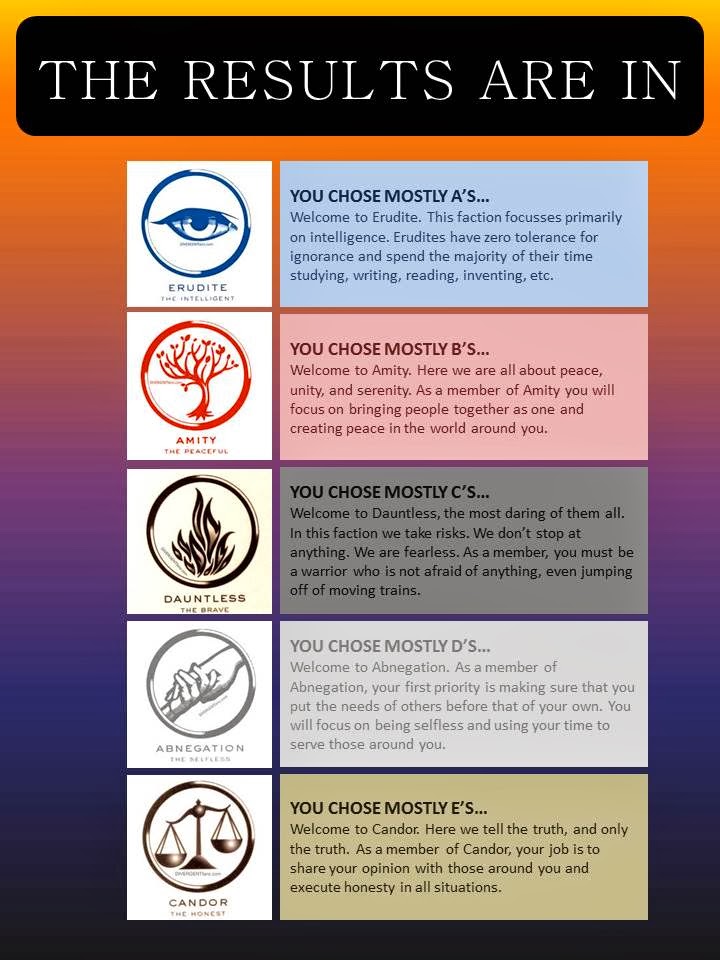
The mock Aptitude Test will include six different questions, each with five possible answers. The questions will ask things regarding your individual personality, your life values, your daily attire, your future career, etc. Each of these questions relate to the Aptitude Test in that they all address the important aspects that go into choosing a faction. Each answer for the questions corresponds to a different faction and based on whichever letter answer is most often chosen, fans and readers are able to determine which faction they would be a part of. If they choose mostly A’s, they are Erudite. If they choose mostly B’s, they are Amity. If they choose mostly C’s, they are Dauntless. If they choose mostly D’s, they are Abnegation. And if they choose mostly E’s, they are Candor.
By recreating the test through a magazine quiz, fans and potential readers are able to really emerge themselves in the novel and feel as though they are one of the characters in the story. Not only do they get the opportunity to have a full-out fan experience, but they are also able to better relate to the characters making their relationship with the book that much stronger.
In order to promote Veronica Roth's book, Divergent, I have created a short quiz, mocking the Aptitude Test featured in the book. In essence, the story is set in a future version of Chicago where the city is divided into five factions: Amity, Candor, Erudite, Abnegation, and Dauntless. Each faction is intended to uphold a different aspect of humanity in order to keep the city at peace. While you are born into whatever faction your parents belong to, when you turn sixteen, you must take an Aptitude Test which predicts what faction you are best suited for based on your personality. After taking the test and receiving your results, you are provided with the opportunity to either remain with your family in your original faction or leave them behind and join a new faction. The mock Aptitude Test is designed to be featured in magazines such as Tiger Beat, Seventeen, Teen Vogue, or any other magazines that typically include quizzes in this format.

WHY:
Not only is the Aptitude Test one of the major elements of the book, but it also serves as the basis for the entire story. Beatrice Prior, the main character of the story, spends the first part of the book struggling to decide where she belongs. While she is born Abnegation, she feels as though she is not “selfless enough” to be considered Abnegation (Roth 378). This insecurity leads Beatrice to question whether Abnegation is truly the right faction for her or if, perhaps, she might be better suited somewhere else. For the majority of her life she had always admired the Dauntless for their “ordinary acts of bravery” and “courage” but up until the Aptitude Test, she had never considered changing factions in that changing factions would mean leaving behind all she had ever known, including her family (Roth 213). When it comes time for the choosing ceremony, however, Beatrice makes the decision to trade in her life of selflessness and service and instead join the Dauntless, taking on a life of danger, risk, and adventure. No longer is she “Tris, the selfless” who always put the needs of others before her own (Roth 487). Instead, she evolves into a whole new person, becoming the bold, daring Tris who fights to the end, not stopping for anyone or anything. If it weren't for the Aptitude Test, none of this would have happened and the story wouldn't have gone anywhere. The test is the ground from which the story is built and therefore, it is one of the most important, if not the most important parts of the book. For this reason, it would be the perfect marketing tool in bringing in fans and potential readers which is why I have decided to recreate the test through a quiz.
The mock Aptitude Test will include six different questions, each with five possible answers. The questions will ask things regarding your individual personality, your life values, your daily attire, your future career, etc. Each of these questions relate to the Aptitude Test in that they all address the important aspects that go into choosing a faction. Each answer for the questions corresponds to a different faction and based on whichever letter answer is most often chosen, fans and readers are able to determine which faction they would be a part of. If they choose mostly A’s, they are Erudite. If they choose mostly B’s, they are Amity. If they choose mostly C’s, they are Dauntless. If they choose mostly D’s, they are Abnegation. And if they choose mostly E’s, they are Candor.
By recreating the test through a magazine quiz, fans and potential readers are able to really emerge themselves in the novel and feel as though they are one of the characters in the story. Not only do they get the opportunity to have a full-out fan experience, but they are also able to better relate to the characters making their relationship with the book that much stronger.
Thursday, December 5, 2013
Blog #2: What is a Book?
What is a book?
In my mind, a book is a gift. What that gift is and how that
gift will be used, however, is up to the reader. The interpretations and the
connections that the reader makes within the book determine what exactly that
gift becomes. It could become a gift of knowledge as the words on the page spew
bits of information into the reader’s mind as they read. It could become a gift
of companionship as the characters throughout the book gradually become more
than just characters, but friends. It could become a gift of comfort as the simple
act of reading brings the reader joy, peace, and serenity. A book could become
a gift of anything: of life, of death, of happiness, of sorrow- it all depends
on the readers themselves and how they see not only the words on the page but
also the deeper meanings found within them.
As for the debate between the “e-book” and the “actual book”,
I tend to lean more towards the side of the actual book. While I agree with
Victor LaValle in that some people may tend to over exaggerate the aspects of a
book, there is some importance, be it slim or not, to the physicality a book offers.
Being able to turn the page of a book and visualize the accumulation of pages
as you near closer and closer to the end is far more satisfactory than simply
sliding your finger across a screen only to see the same sight you saw before,
the only difference being the page number in the bottom corner. There is no
gratification, no real “award” to reading an e-book. Maybe it’s just me, but in
my mind, there is no greater sense of accomplishment than physically turning
the very last page of a book. The surge of triumph and success that rushes
through your body as you realize you have read an entire book, cover to cover,
page to page- that is something that you simply cannot get from reading an
e-book.
I don’t know what is to come for the book world, whether the
apocalyptic “death” of the book is truly as near as most believe it to be. What
I do know, however, is that even if the world becomes full of Kindles and Nooks
and what not, I will always value the physical book over the e-book and the
many gifts it has to offer.
Thursday, November 21, 2013
Blog #1: Why I Read

For me, reading is an escape. It brings me to this surreal place in life where all my worries, all my problems, all my anxieties simply disappear. When I read I no longer have to think about everything that is going on in the world around me. Be it problems with my family, arguments between friends, or even work at school, all of my issues become insignificant when I immerse myself into a book. The characters in the book become my family. Their friends become my friends. Their problems, mine. In other words, the book becomes my life. It’s what I spend the majority of my time with, it’s what I look forward to coming home to everyday, it’s what I love doing. It’s everything. And the best part about reading is that it’s always there for you. It’s never going to go away. In life, people come and go. Experiences pass. Time continues on. But with reading, there is always another book. There is always another story. And even if there isn’t, you can relive your favorite stories over and over again as many times as you want. Reading is something that is guaranteed. It’s stable. Unchanging. And that is why I love reading.
As Ernest Hemingway said, “There is no friend as loyal as a
book”.
Subscribe to:
Posts (Atom)